A Practical Guide to How You Check the Authenticity of a Valentino Garavani Bag
Treat authentication as a sequence rather than a glance, because the order of the steps matters more than most guides admit. Run it in the wrong order and you can spend twenty minutes poring over stitching on a bag built by a company other than the one you have in mind. What follows is that sequence, written for someone holding a bag or reading a detailed listing, with every step doing a single job and then passing on to the next. Two warnings before you begin. There is no date-code system here of the sort some buyers expect, and several details circulating as decisive proof are nothing of the sort, so each step spells out the limits of what it proves. None of this replaces a professional authentication service on a high-value purchase; it just helps you see when one is worth the fee.
Step 1. Identify the maker before anything else
This comes first because getting it wrong invalidates everything after it. The Valentino name covers two unrelated companies: the Rome couture house founded in 1960, whose leather goods are stamped VALENTINO GARAVANI, and Mario Valentino S.p.A., a Naples leather goods and footwear house founded in 1952, which sells as Valentino by Mario Valentino. A 1979 coexistence agreement binds the couture house to use valentino structured tote GARAVANI alongside VALENTINO on leather goods and their advertising, and that, not styling, is why the second word exists. A genuine Mario Valentino bag will fail every remaining check on this list while being completely authentic, and the mis-selling runs both ways. Study the branding first of all, establish which company you are dealing with, and only then ask whether the bag is real. If the outside says only Valentino and the inside says Mario Valentino, you are looking at a genuine bag from the Naples company, not a fake valentino garavani bag.
Step 2. Give the interior tag a word-by-word reading
The interior tag is the highest-value single check, and it rewards patience. A genuine piece should show VALENTINO and GARAVANI in capitals alongside MADE IN ITALY, because the brand’s own product pages confirm Italian manufacture. The attachment comes before the wording: it should be sewn down on all four sides, flat, with no loose corner and no adhesive. Only then read the lettering, checking that font weight is consistent across every character and that the stamp is pressed evenly rather than smudged, doubled or shallow in places. Since fakes usually copy the text well and the pressure poorly, judge the stamp itself, not only what it reads. A missing tag, or one carrying only one of the two words, counts as a serious concern.
Step 3. Read serial numbers as evidence, and drop the date-code idea
Serial numbers do turn up, as a rule on a tag inside an interior pocket, often in black, cream or light brown. Shoot it and compare: the stamping should be as clean as on the main interior tag. The catch is simple: the serial is not universal across the house, and plenty of older models may never have carried one. A missing serial does not prove a bag is fake, and whoever tells you otherwise is oversimplifying; presence proves little either, since numbers are trivially copied. Remember also that this house runs no date-code system of the kind used elsewhere: nothing here decodes to a factory and a week of production. A listing that quotes a date code shows the seller is either on about a different brand or inventing reassurance, and both readings are reasons to slow down. The same goes for the related folklore: the claim that a lining colour proves authenticity is not verified and should never be decisive.
Step 4. Put the authenticity card in its place
By report, these bags come with a card, with model specification, a serial number and a Made in Italy line that lines up with the interior tag. Resale and authentication guides are where that description comes from, and never an official statement made by the house, so take it as market practice. Given a card, the one useful test is agreement: card number and bag number should be the same, and a mismatch counts as a genuine red flag. No card is not a finding, since pre-owned bags regularly show up without one after years of ownership and resale. A card is sometimes priced by sellers as a certificate of authenticity, though it is nothing of the sort, and cards are copied as easily as tags. A card counts for exactly as much as it corroborates, not the bare fact that it exists.
Step 5. Inspect the hardware and its engraving
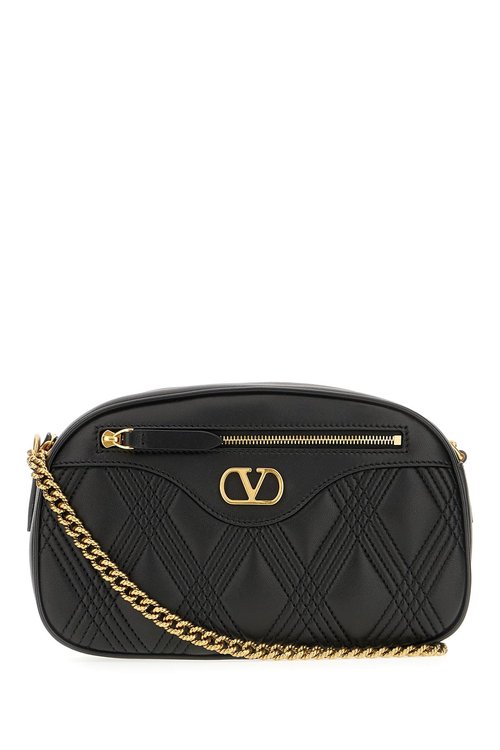
The hardware is where counterfeit economics become visible, because engraving costs money and printing costs almost nothing. A genuine piece carries engraved rather than printed logos, carrying depth a fingernail can read and edges that stay crisp under magnification. On the line, zip pulls have been observed square with rounded edges, with that same deep engraving, and should feel weighty rather than hollow. The metal reads restrained, never brassy; observed finishes include antique-brass, light gold and platinum, which makes a loud yellow gold something to question. Every piece of hardware should match every other in tone and finish, because mismatched pieces betray parts bought from different places. These finishes are plated, which matters a great deal for how you care for the bag.
Step 6. Go through the studs and the stitching
The studs are a test worth running, since the house signature is a stud. Height, facet angle and flat top should be identical from pyramid to pyramid, and none should rock, spin or sit proud of the leather. The other half of the test is spacing, because regular spacing along a strap or flap edge is hard to fake at volume and easy to check by eye. Next, work along the stitching: it should be even in length, aligned along the seams and consistent in density panel to panel. Wandering stitch lines, loose threads and changes in tension across one seam are among the most reliable counterfeit indicators, because these are the hardest details to industrialise cheaply. The long edge of the bag deserves a slow look, as that is exactly where inconsistency turns up.
Step 7. Check the price, then judge the seller
Treat price as a check, not a courtesy, and it catches listings that survive every physical test in photographs. Hold the asking price up against observed 2026 market prices on the brand’s own United States site: Rockstud runs $1,250 to $2,100, Rockstud Spike $2,400 to $3,700, Locò $2,700 to $5,900, VSling $3,350 to $6,550 and VLogo Signature $650 to $3,750. On the pre-owned market, one major platform’s observed retention puts the house near 41 per cent of retail, with motif styles around 50 to 58 per cent, so a used valentino shoulder bag at a tenth of retail is telling you something. Then judge the seller as hard as you judged the bag: the brand’s own boutiques and webstore, or named authorised retailers such as Neiman Marcus, Bergdorf Goodman, Saks Fifth Avenue, Mytheresa, Net-a-Porter and Farfetch. On the resale side, established platforms including Fashionphile, The RealReal, Rebag, Vestiaire Collective, Collector Square and 1stDibs authenticate in-house before anything is listed. If the bag passes but seller and price both look wrong, leave it and buy the same model from somewhere accountable.
The checklist, condensed
Use the table as a summary, not a substitute for the steps above, because most mistakes happen in the third column. Several checks are strong when they fail and weak when they pass, and that asymmetry is the thing worth internalising. Where the interior tag is missing, that is damning; a present one is merely encouraging. A serial that does not match is damning; a missing serial says very little. Hold the order intact, since settling the maker first saves you from running a checklist that cannot apply. Once two rows or more go negative means stopping and paying for a professional opinion.
| The check | What a genuine piece shows | What failure actually proves |
|---|---|---|
| Maker identity | VALENTINO GARAVANI on the leather goods | Valentino outside, Mario Valentino inside: a separate company, and a genuine one |
| The interior tag | Capitalised VALENTINO and GARAVANI with MADE IN ITALY, secured on all four sides | Missing tag or one word only: a serious concern |
| The serial number | Typically on a tag within an interior pocket, with clean stamping | A missing serial alone proves nothing; older models may never have carried one |
| Any date code | There is none; the house runs no date-code system | Any quoted date code shows the seller is describing a different brand |
| The card | Reported to show model, serial and Made in Italy, in agreement with the tag | Absence is normal, since pre-owned bags often arrive without one |
| The metal parts | Engraved not printed, the cut deep and even, the tone restrained | Printed, faint or smudged marking counts as a strong negative |
| The studs and the stitching | Even pyramids, even spacing, aligned seams, steady stitch density | Wobble, uneven spacing or wandering seams are strong negatives |
Leave a Reply